



Ethics Literacy in the Age of AI
By Lea-Ann Germinder, Ph.D, APR, Fellow PRSA
September 2026
This Ethics Month asks practitioners to slow down and, with AI, to look at the values underneath the tools they’re adopting. For longtime practitioners like me, midcareer and newly minted pros, that’s harder than it sounds with AI, where the pace of adoption often outruns our capacity and that of our organizations to think through what it’s doing to truth, trust and transparency along the way.
A recently introduced framework, AELHA, is based on the original contribution of my doctoral dissertation at the University of Missouri School of Journalism, “Constructing Responsible AI in Public Relations: Perspectives on Ethical Adoption from Generative AI to Agentic Systems.”
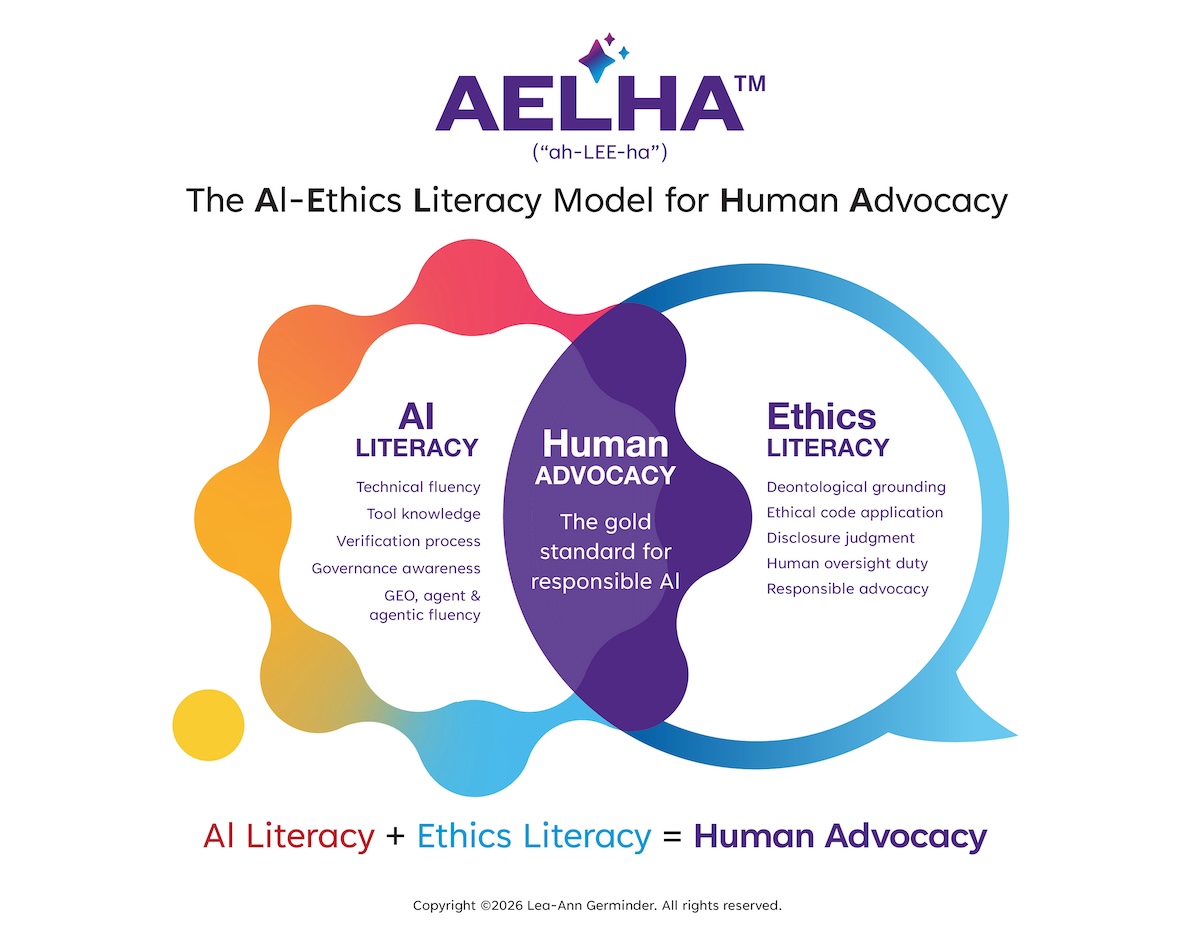
AELHA (pronounced “ah-LEE-ha”) stands for AI Literacy plus Ethics Literacy equals Human Advocacy. The framework draws on constructivist grounded theory and three scholarly traditions: diffusion of innovations, deontological ethics, and responsible advocacy.
AELHA’s premise is that technical skill and ethical judgment can’t be developed on separate tracks. Adopting AI by building technical literacy without ethical literacy, it is argued, is how organizations lose trust in the first place.
Of the model’s two literacies, AI literacy, meaning tool fluency, verification processes, and governance awareness, is the half most organizations are already racing to build. Ethics literacy is the half Ethics Month exists to press on and is the focus of this article.
Two triads underneath ethics literacy
Ethics literacy is framed around two triads practitioners will recognize from the profession’s foundations, even as AI raises the stakes of applying them.
The first is a triad of values: truth, trust and transparency. AI puts pressure on all three simultaneously, and often within the same piece of content. Synthetic or AI-assisted content strains truth when it states things with more confidence than the underlying model actually has.
Opaque systems, agentic tools making decisions practitioners can’t fully trace, strain trust, because trust depends on people being able to explain how a conclusion was reached. Undisclosed automation strains transparency, the simplest and yet the most easily violated of the three, i.e., does the stakeholder know a machine had a hand in what they’re reading, seeing or being told?
The second is a triad of practitioner roles: advocacy, disclosure and counsel. Advocacy is the duty to represent an organization’s interests without misrepresenting facts to the public, a duty that gets harder to honor when AI can generate plausible-sounding claims faster than anyone can verify them. Disclosure is the judgment call about when and how AI’s role in a piece of communication needs to be made visible, a decision that has no universal answer and depends on context, audience and stakes. Counsel is the obligation to tell leadership what it may not want to hear: that a faster AI-driven path isn’t always the one that protects the organization’s credibility.
AELHA’s contribution is putting these two triads in direct relationship. Ethics literacy, in the dissertation framing, is the capacity to hold truth, trust and transparency steady while performing the roles of advocate, discloser and counselor in an AI-mediated environment.
That’s also, not coincidentally, the same territory of PRSA’s Code of Ethics values (advocacy, honesty, expertise, independence, loyalty and fairness) already stakes out. AI doesn’t dismiss those values; it raises the frequency and the difficulty of the decisions that test them.
Where ethics literacy shows up in practice
Ethics literacy isn’t a training module you check off once. It shows up in specific, recurring decisions:
- Disclosure judgment. Does this piece of AI-assisted content need a disclosure statement? Does the answer change if it’s a press release versus a social post versus a client-facing report? Practitioners need a standing framework for this decision, not an ad hoc one made under deadline pressure.
- Human oversight as a duty, not a formality. As agentic systems take on more autonomous tasks, drafting, scheduling, even limited decision-making, the question isn’t just whether a human reviewed the output, but whether that review was substantive enough to catch an error in judgment, not simply a typo.
- Naming the gap. Teams that can talk about “AI literacy” fluently but go silent on “ethics literacy” have an imbalance worth surfacing to leadership before it surfaces as a public failure.
- Counsel under pressure. Finally, when a client or leadership team wants to move faster than ethical review allows, ethics literacy is what equips a practitioner to make the case for slowing down, and to do so with the same confidence they’d bring to any other strategic recommendation. In truth, it may be the most difficult ethical test of all.
A model meant to be used
Dean Kruckeberg, Ph.D, APR, Fellow PRSA, a former BEPS member and PR professor at the University of North Carolina at Charlotte, said my research and especially the AELHA model will help provide insights and a better understanding of the impact of artificial intelligence on public relations.
The scholarly grounding continues to develop, including an August presentation at the Association for Education in Journalism and Mass Communication (AEJMC) on AELHA’s truth-trust-transparency and advocacy-disclosure-counsel dimensions, signaling that the model is meant as a working reference point for both practitioners and academia alike.
For this Ethics Month issue, that’s the point worth considering. Ethics literacy isn’t the softer half of AI adoption, secondary to getting the tools right. It’s the half that determines whether truth, trust and transparency survive the transition, and whether practitioners can still advocate, disclose and counsel with integrity once AI is doing some of the work.
AELHA offers a concrete exercise for Chapters and teams this month: Don’t just ask whether your organization has an AI policy. Ask whether anyone owns the ethics literacy half of that policy as seriously as the technical half. That’s a discussion that extends well past Ethics Month.
Anthropic’s Claude Sonnet 5.0 was used as an editorial assistant for this article; however, the article is the author’s own work product.
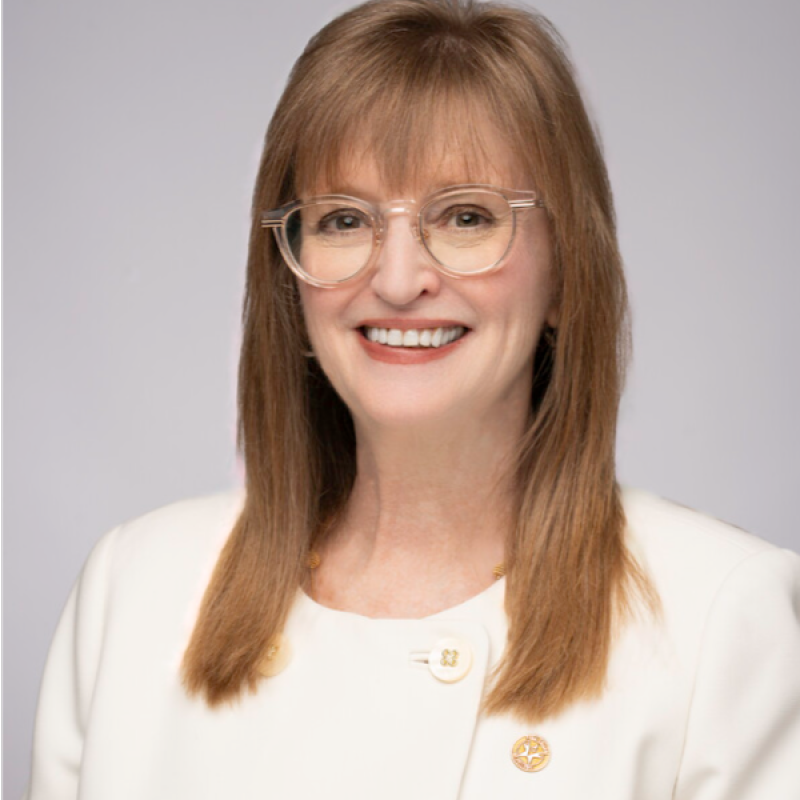
Lea-Ann Germinder, Ph.D, APR, Fellow PRSA
Lea-Ann Germinder, Ph.D, APR, Fellow PRSA, has been a PRSA member since 1982. She is a PR practitioner-scholar and former president of PRSA’s New York and Greater Kansas City Chapters, and a former member of the PRSA Board of Directors. She developed the AELHA model as part of her doctoral research at the University of Missouri School of Journalism. She is currently a member of the PRSA Board of Ethics and Professional Standards (BEPS).