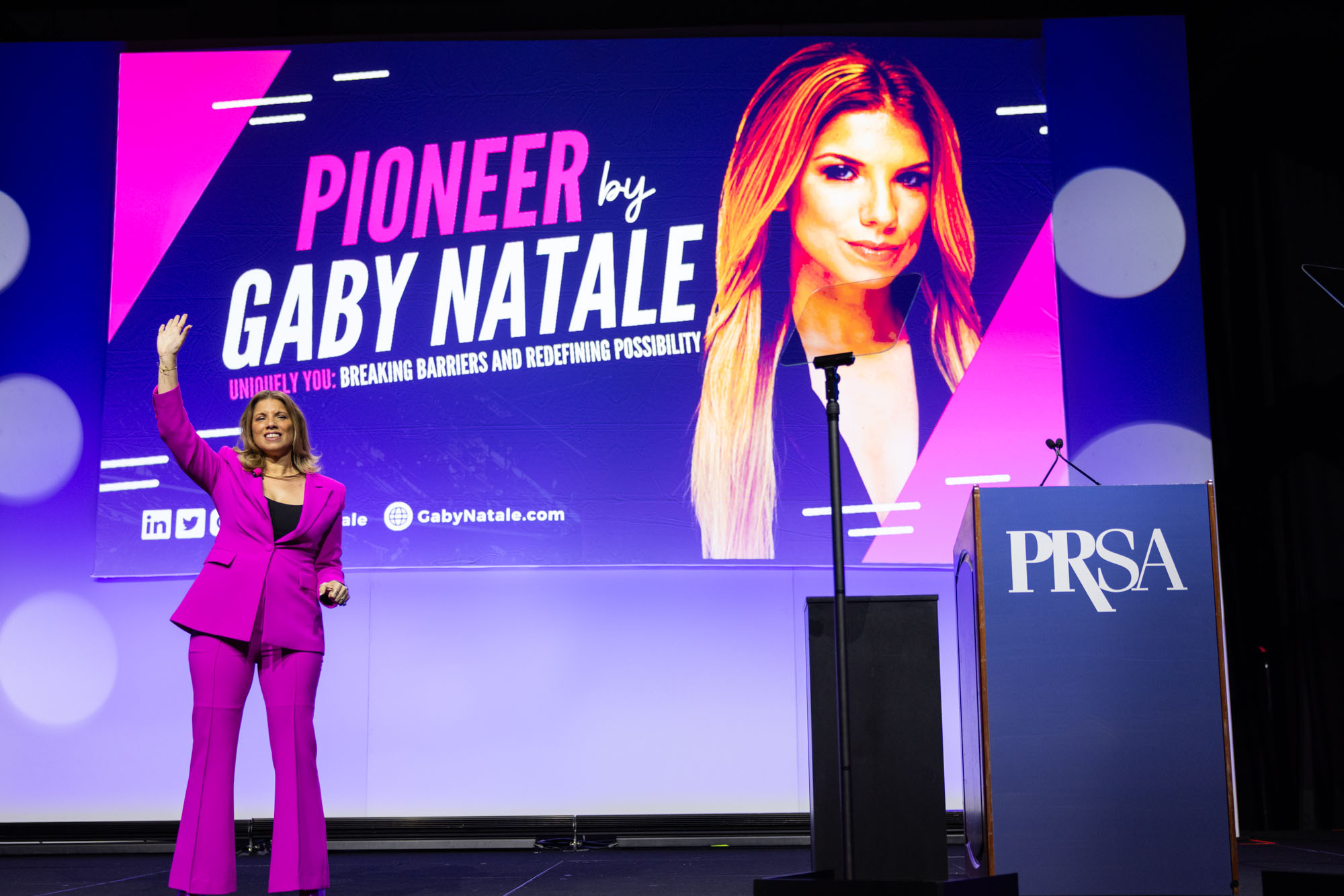




Gaby Natale Challenges PR Pros to Embrace Their Pioneer Spirit
By John Elsasser
November-December 2026
Gaby Natale knows what it’s like to hear “no.”
Early in her career as a public relations professional in Washington, D.C., she pitched clients to major newsrooms without established contacts, budget or fluency in English.
Those early experiences helped shape the core message she brought to her General Session on Oct. 20: Rather than following paths established by others, communications professionals should recognize what makes them unique and use those qualities to build something new.
From emulating to pioneering
Natale contrasted two distinct approaches to professional and personal growth: the “emulator mindset” versus the “pioneer spirit.”
The emulator approach involves using someone else’s accomplishments as a blueprint for success. While that playbook can produce solid results, she noted, it rarely challenges the status quo. The alternative is embracing a pioneer spirit—believing in a vision before there are metrics to validate it and moving forward without an established road map.
That shift required overcoming deep personal doubts about whether she belonged in certain professional spaces. Arriving in the United States from Argentina, Natale admitted her biggest fear was public speaking in English, worried her thick accent would cause audiences to question her credibility.
“I couldn’t see people like me on stages. I couldn’t see people like me in leading roles,” she recalled. That realization led to the question at the heart of her presentation: “How to be what you can’t see?”
Her answer was to trust her inner vision rather than waiting for someone else to show what was possible.
“Inner voice over outer noise,” she told the crowd.
Turn discomfort into action
For Natale, developing a pioneer spirit requires three steps: embracing uniqueness, breaking barriers, and redefining what’s possible by joining forces with other pioneers. She urged communicators to pay close attention to discomfort, which often acts as an early indicator that an established approach no longer fits.
“Discomfort is our wake-up call to pioneer,” she said.
Early in her broadcasting career, producers pressed her to adopt one of two familiar television personas: the glamorous entertainment reporter or the formal, serious news anchor. Neither felt authentic.
“I don’t wanna be a wannabe. I wanna be me,” she recalled deciding.
She left her anchor position and began producing an independent television program from a carpet warehouse in West Texas. The local show eventually expanded into a regional and then nationally syndicated program, earning three Emmy Awards along the way.
The pioneer’s growth trifecta
To help communicators advance their careers or pitch bold ideas, Natale outlined her “Pioneer’s Growth Trifecta,” a framework where three core elements — excellence, consistency, and visibility — must work in tandem.
Excellence requires delivering work that can withstand the extra scrutiny innovation often brings, while consistency demands showing up regularly and intentionally rather than relying on sporadic bursts of effort.
Visibility, however, is where PR professionals frequently struggle, as they spend most of their careers positioning other people and organizations in the spotlight.
“Visibility is not about being selfish. Visibility is not about being vain,” she said, drawing nods across the room. “Visibility is a critical tool that we have at our disposal to raise awareness about the contributions that we and our teams are making.”
When any single element is missing, distinct breakdowns occur. High visibility and consistency without excellence leads to the “infomercial dilemma,” where audiences might try an offering once but never return. Pairing excellence and visibility without consistency creates the “one-hit wonder dilemma,” producing a splashy initial impression that quickly fades.
The most concerning gap for Natale is the “hidden genius dilemma,” where talented professionals lack visibility altogether. Fear of rejection often keeps capable communicators from claiming the recognition and opportunities they deserve.
“Underplaying our own contributions to look humble is helping no one, and it’s hurting all of us,” she warned.
Finding opportunities others overlook
Natale’s final lesson focused on identifying strategic white spaces through the lens of one’s own life experience. She challenged communicators to evaluate three questions: What stories are you uniquely qualified to identify? What emerging opportunities can you recognize? And what overlooked needs exist within your industry?
She illustrated the point with a deeply personal story. On Valentine’s Day in 2024, Natale nearly skipped a routine mammogram. Keeping the appointment led to a breast cancer diagnosis. Following surgeries, radiation, and chemotherapy, she drew warm applause when she shared her latest news with the ICON audience: She is completely cancer-free.
That experience reshaped her professional focus. Combining her communications background and bilingual skills, she partnered with Susan G. Komen as an ambassador.
Later, after experiencing a hot flash on live national television brought on by treatment-induced early menopause, she searched for reliable medical resources in Spanish — only to find information scattered across disparate sources with minimal bilingual options.
Recognizing an unaddressed need, she launched Menopausia.com, a bilingual platform focused on perimenopause and menopause. The venture merged her personal story, professional toolkit, and an underserved audience — the exact combination she urged attendees to look for in their own work.
The experience illustrated Natale’s larger message: Opportunities to pioneer can emerge from unexpected places, including personal challenges.
“Pioneers are ordinary people who chose to see the world and themselves in an extraordinary way,” she said.
Backstage Q&A With Gaby Natale
Many PR professionals work within tight budgets and established processes. How can they develop a pioneer mindset when there’s little room to experiment?
I shared three questions during my presentation: What are the stories? What are the opportunities? And, especially, what are the white spaces that you are uniquely qualified to identify?
When you tap into everything that makes you who you are and use it to your advantage, you begin to see opportunities differently.
I’ve always been an underdog. That’s been the story of my life, whether in television or other areas of my career. The key is to use what makes you unique to your advantage and find that white space where you see an opportunity hidden in plain sight.
Maybe there’s a blind spot in an industry or a company. Everyone complains about something, or something isn’t as efficient as it could be, but nobody does anything about it.
That’s where the opportunity comes in.
If you identify that white space and get there before everyone else, you’ve got a fortune. You’re not competing. You’re there, and it’s all yours to take.
What’s one thing PR professionals can do when they return to work to start thinking more like pioneers?
One key takeaway, based on the questions I received [at ICON], is the importance of visibility.
We talked about embracing excellence and consistency, but many of the questions from PR professionals highlighted the challenge of making their own work visible.
There’s an irony here. We’re used to making our clients or companies shine, but we’re often the hidden geniuses. We have the consistency and the excellence, but for some reason, we don’t have the visibility.
Some of the people I spoke with don’t even feel comfortable embracing that visibility.
But we need to recognize visibility as a critical tool for raising awareness of what we’re doing and the contributions we’re making — individually, collectively and as an industry.