



Tony D’Angelo on Leadership, Lessons Learned and the Future of PR
By John Elsasser
November-December 2026
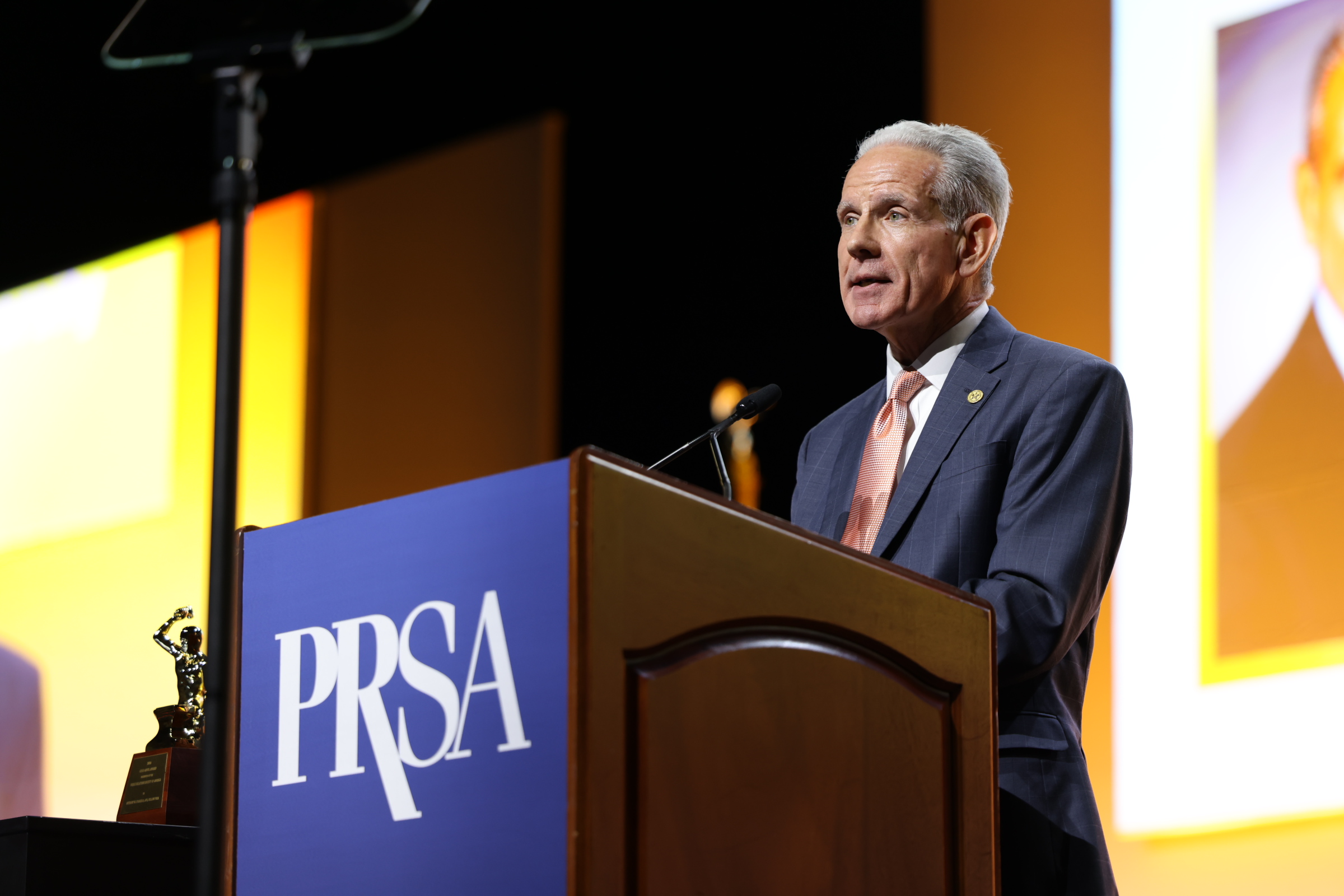
Accepting PRSA’s 2026 Gold Anvil Award at ICON 2026 on Oct. 18, Anthony W. D’Angelo, APR, Fellow PRSA, urged communicators to recognize the influence they have on others — even when they may never know the full extent of their impact.
Amid polarization, misinformation, and AI-driven deception, D’Angelo urged PR professionals to uphold the highest ethical standards and use their influence to make a difference. “Please don’t underestimate your power or our shared responsibility,” he said.
D’Angelo, professor of practice, Public Relations Department chair and director of executive education at Syracuse University’s Newhouse School of Public Communications, received PRSA’s highest individual honor for lifetime achievement and exceptional leadership.
He joined the Oct. 29 edition of Strategies & Tactics Live on LinkedIn to reflect on his career, share leadership lessons and discuss the future of the profession.
Here are highlights from that conversation with Editor-in-Chief John Elsasser, edited for length and clarity.
What lessons have stayed with you throughout your career?
My own development turned a corner when I started to care about the success of the people around me. When you do that, the better a leader you will be.
In your Gold Anvil remarks, you encouraged PR professionals to recognize their power to make a difference. What does that look like in the everyday work of a communicator?
The calling that we have, and the challenge, is to connect communications outputs and outcomes with organizational outputs and outcomes. Because if you don’t do that, you’re not adding the full value that you can as a communicator.
You’ve worked in corporate communications, led within PRSA and now teach future professionals. What principle has remained constant across those settings?
I’m going to offer a quote from [former PRSA leader] Patrick Jackson that has stayed with me: “People want to be engaged, not told; served, not sold.” That has been a touchstone for me throughout my career, the idea that you’re looking to engage, not dictate.
What separates a good communications manager from an effective communications leader?
There’s a saying that “A good manager does things right, and a good leader does the right thing.” The best leaders bring out the extra in someone. Maybe they don’t even know they have it.
I’ve had leaders who, to my undying gratitude, stretched me. I didn’t see myself performing in certain ways or in certain roles. And it wasn’t always comfortable to be stretched. But I am so glad it happened.
What advice would you give a communicator who needs to challenge a senior executive or deliver an unwelcome recommendation?
You need to apply some starch to your spine in these situations. You have to have competence in what you are doing [and] confidence in yourself. Speak softly, with loud data. Leaders respect the data. You might still lose, but leaders have a sense of when somebody is coming from the right place.
What do leaders underestimate about communicating organizational change?
Leaders and organizations tend to fly right to prescribing solutions. And that short-circuits what should be an iterative learning process for the organization. The idea is that we assemble the facts and evaluate them together, and this should be collaborative.
Going back to Pat Jackson, people want to be engaged. They don’t want a dictate about how to change. Because most of us reflexively push back when that happens.
Beyond the technology itself, what concerns you most about how AI could affect PR professionals’ judgment, skills and credibility?
I worry about the phenomenon described as “cognitive offloading.” Rather than applying critical-thinking skills ourselves, we’re going to ask Claude or ChatGPT for the answer. And that interferes with the learning process.
I also worry about the erosion of skills. What we try to do in the classroom is equip students to answer this question in a job interview: “How are you going to add value to our use of these AI platforms?”
The answer we try to impress upon students is: You have to be a professional writer and editor. The differentiating value that we bring is professional communication.
You’re back at Newhouse, where you were once a student. What are today’s students teaching you about the future of communications?
I’m inspired by our students. They’re smart, inquisitive, engaged and passionate. I find that enormously energizing. I’ve followed some influencers based on their recommendations.
What strengths stand out among emerging professionals today? And where do you see gaps in their preparation?
The gap is often in soft skills. Networking, for example. One strength is inquisitiveness, which is a good skill for all of us to apply. The other is critical thinking. We want them to challenge what they see, what they’re digesting, and to think about who is saying this and why they are saying it.
And is this a human, or a bot? We live in a space today where you can’t tell. We all need a higher level of media literacy.
What still excites you most about public relations and its future?
The rate of change is accelerating like a hockey stick. Learning has to be continual. And that I find so exciting, so engaging. I’m jealous of students and young professionals. They have a great future in front of them.